Every day, you spend an average of 3 hours and 40 minutes on your phone. During that time, you generate around 200 data points that are collected, analyzed, and sold — before you even think about dinner. It’s a subject I was aware of, but until recently I “instinctively” dismissed: how the apps on my phone manipulate my brain. Not metaphorically. Literally. Digging into this topic led me to create CogniAware — a free Android app that shows you in real time what techniques social media apps are using on you. Before I tell you what it does — let me explain why it was built in the first place.
What is cognitive warfare, and why should you care
In 2021, NATO published a report that quietly changed the way we think about security. Analysts at the NATO Innovation Hub recognized the cognitive domain — the human mind — as the sixth operational dimension. Alongside land, sea, air, space, and cyberspace.
Cognitive warfare refers to operations designed to influence not WHAT you think, but HOW you think. It’s about exploiting cognitive biases, manipulating emotions, polarizing societies — and doing all of it at industrial scale, powered by algorithms.
And here’s the key part: the tools of this warfare are already on your phone. You use them every day. You call them Instagram, TikTok, Facebook, YouTube.
How your phone manipulates you
This isn’t a conspiracy theory. These are documented mechanisms, confirmed by former Big Tech employees (Tristan Harris from Google, Frances Haugen from Meta) and dozens of scientific studies.
The dopamine loop
Every notification, like, and comment triggers a micro-release of dopamine. The key mechanism is variable reinforcement — you don’t know when you’ll get a reward, so you keep checking. It’s the exact same mechanism used in slot machines. Research shows that even the sound of a notification activates the brain’s reward center.
The filter bubble
Recommendation algorithms eliminate content that contradicts your beliefs. The result? Radicalization of views and loss of the ability to engage in dialogue. MIT research found that false news spreads six times faster than the truth — because it triggers stronger emotions, and the algorithm promotes engagement.
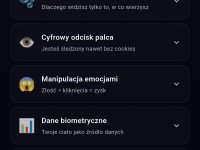
Fingerprinting
Even without cookies, you’re being tracked. Your device creates a unique “fingerprint”: screen resolution, installed fonts, OS version, time zone, language settings. Combined, this data identifies you with over 99% accuracy.
Emotion manipulation
Internal Facebook documents, leaked by Frances Haugen in 2021, confirmed what many suspected: content that triggers anger generates five times more engagement. The algorithm promotes polarizing posts because anger = comments = time in app = ad revenue. Your emotions are being monetized.
Biometric data
AR filters scan your facial geometry. Accelerometer data reveals your gait. Your typing rhythm is as unique as a fingerprint. Your body generates data — and that data is a commodity.
Why I built CogniAware
When I started digging into this, I realized the information about these mechanisms is out there — but the problem is that it’s scattered across different places. The average user doesn’t have time to search for it, and even if they did — there’s no tool that shows them these mechanisms in action, on their own phone.
I thought: what if there was an app that doesn’t block, doesn’t scare, doesn’t moralize — but simply shows you? One that says: “hey, you just spent 47 minutes on Instagram, and this app may have active access to your camera, microphone, and tracks you through 7 different mechanisms.”
That’s how CogniAware was born.
What CogniAware does
CogniAware is a free Android app that acts as your “cognitive shield.” Here’s what it does:
Screen time monitoring
If you want it to — it tracks in real time how much time you spend in each app. Not in the “your screen was on for 4 hours” style — but with a detailed history broken down by individual app. You can set a daily limit, and the app sends you a push notification when you exceed it.
Tracking knowledge base
Every popular app has a detailed profile: what tracking methods it uses (location, microphone, cookies, fingerprinting, network connections, device identification) and what the threat level is. You don’t need to read an 80-page privacy policy — CogniAware translates it into plain language.
Camera and microphone audit
One click scans all installed apps and shows which ones have access to your camera and microphone. With a quick link to system settings so you can revoke access immediately.
Protective “shields”
A real-time alert system. You enable “shields” for the tracking categories you care about, and you get a notification whenever a high-threat app becomes active.
Home screen widget
Without opening the app, you can see: the number of active “shields,” total screen time today, and current threat level. A constant reminder that you’re monitoring your digital hygiene.
Background operation
CogniAware keeps running even after you close the app (though sometimes the system likes to sneak in and — whoops — shut it down ;) ). It automatically restarts after a phone reboot. A persistent notification keeps you informed of the current status.
Educational section
The “Discover” tab is a mini-course on cognitive warfare in a nutshell. Articles about tracking methods, dark patterns, and privacy protection — written so that anyone can understand them.
Why CogniAware is Android only
This is the question I get most often, and the answer is simple, though ironic: Apple protects your phone from other apps so aggressively that it doesn’t allow protective apps to function effectively either. On iOS, there’s no access to the UsageStats API (your screen time data belongs to Apple, not you). You can’t monitor other apps’ permissions. You can’t run in the background with a persistent notification. iOS sandboxing makes virtually every feature CogniAware offers on Android impossible.
The paradox is that the same restrictions designed to protect you from malicious apps also prevent protection against legitimate tracking. Apple controls who protects you — and it’s always Apple.
If Apple opens these APIs in the future, CogniAware will appear on iOS that same day. For now — Android is the only platform where this type of app makes sense.
Zero data collection. Seriously
I know how it sounds when a privacy app says “we don’t collect data.” So let me be blunt: CogniAware has no server. No user accounts. No registration. No analytics. No Firebase. No trackers of any kind. Everything runs locally on your device. Period.
If I collected data on users of an anti-tracking app, I’d be exactly what this app warns against...
What’s next
CogniAware is available for free on Google Play. No premium version, no ads, no catch. I built this project because .... I can — simple as that, and because I believe digital awareness isn’t a luxury — it’s a necessity.
If you want to support development, you can buy me a coffee via Buy Me a Coffee. You’ll find the link inside the app. And if this article makes you check even once which apps on your phone have camera access — that’s already my personal win :).
Maciej Frankowski Creator of CogniAware